
| TL;DR Short answer: For most businesses, build a website first and use social media second. You own a website. You rent a social profile. Why: Search and AI answer engines still pull from websites, shoppers still look for one before they buy, and only a website gives you an audience nobody can switch off. Exceptions: Creators, personal brands, and Gen Z-focused consumer products can start on social, as long as they capture email addresses from day one. Best setup: A simple website as the hub, one or two social channels as spokes, and an email list connecting them. |
Picture this. It is Tuesday morning, and your Instagram account is suspended. Years of posts, followers, and customer conversations are unreachable, and you have no way to contact the people who followed you.
That risk is why the website vs social media question matters more in 2026, not less. Search is becoming more zero-click, AI tools answer questions before anyone visits a page, and social feeds have become search engines for younger buyers.
This guide gives you the direct answer, a side-by-side comparison, a decision table by business type, a step-by-step framework, and how to choose the right partner to build your website.
What is the difference between a website and social media?
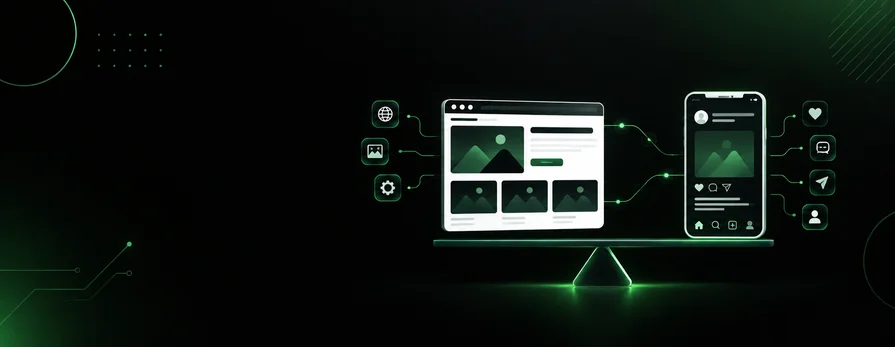
| Website vs social media is a choice between owned and rented digital space. A website is a property you control, with your own domain, design, and customer data. Social media is a set of platforms, such as Instagram, TikTok, Facebook, and LinkedIn, where you build an audience under each platform’s rules and algorithms. |
What is a website?
A website is your business’s home on the internet. You choose the domain, the layout, the content, and how visitors move from curiosity to purchase. It is also where search engines and AI tools go to learn what your business does.
What is social media?
Social media is built for engagement. Platforms like Instagram, Facebook, TikTok, LinkedIn, and YouTube let you post updates, answer questions in real time, and reach people through shares. The platform owns the space, sets the rules, and decides who sees your content.
Think of it as renting a storefront in someone else’s mall. You can decorate it, but the landlord can change the terms.
Free demo website & AI-search audit
Is your business easy to find — by Google and by AI?
Most searches now end without a click, and the ones that don’t often come from an AI summary, not a social feed. Ezee Growth will check whether your website and social setup are working together — or costing you customers — and hand you a clear list of fixes, free.
Website vs social media: side-by-side comparison
| Factor | Website | Social media | Edge |
|---|---|---|---|
| Ownership and control | You own the domain, design, and data (as long as you renew) | Platform owns the space and sets the rules | Website |
| Search and AI visibility | Indexable, structured, and citable; can rank for years | Profiles and posts can rank, but you control little of how they appear | Website |
| Discovery and virality | Slower build; depends on SEO and links | Shareable content can spread fast | Social |
| Trust and credibility | Signals a legitimate business; shoppers expect one | Reviews, comments, and social proof | Website |
| Conversion | Built for forms, bookings, and checkout | Limited; platform decides which commerce features exist | Website |
| Customer data | Email list and first-party analytics | Platform holds follower data | Website |
| Cost to start | Domain plus a plan | Free to create, but costs time every week | Social |
| Time to first results | Weeks to months for organic search | Days to weeks with consistent posting | Social |
| Algorithm and policy risk | Low | High | Website |
| Real-time engagement | Limited (forms, chat, comments) | Instant two-way conversation | Social |
Bottom line: Websites win on ownership, trust, conversion, and durability. Social media wins on speed, reach, and conversation. That is why the strongest strategies use both.
Should you build a website or use social media first?
| Most businesses should build a website first and add social media second. A website gives you a domain, search visibility, credibility, and a way to collect email addresses that no platform controls. Social media then drives discovery to that hub. The main exceptions are creators, personal brands, and Gen Z-focused consumer products. |
Best way to choose: start with your business type
| Business type | Start with | Why | Add next |
|---|---|---|---|
| Local service (plumber, dentist, salon) | Website plus Google Business Profile | Customers search for “near me” and want hours, proof, and booking | Facebook or Instagram for reviews and before-and-after posts |
| B2B, SaaS, consultants | Website | Longer sales cycles need depth and credibility | LinkedIn thought leadership that sends readers to webinars or consultations |
| Ecommerce and retail | Online store plus Instagram or TikTok | You own checkout and data; social drives discovery | Email flows for abandoned carts and repeat buyers |
| Restaurants and hospitality | Website (menu, reservations) plus Google Business Profile | Diners check the menu and hours before visiting | Instagram for food and atmosphere |
| Creators and personal brands | Social first, with email capture from day one | The audience already lives in the feed | A website within 90 days for products, bookings, and sponsors |
| Gen Z-focused lifestyle (fashion, beauty) | Social first, website in parallel | Discovery happens in feeds | A store or landing page to capture direct sales |
Three questions to confirm your choice
- What is your main goal? Sales, leads, and bookings point to a website. Awareness and community point to social.
- Where does your audience look for answers? Buyers who search Google or ask an AI assistant need a website to find. Buyers who scroll TikTok need social presence.
- What can you maintain? One well-kept website and one active channel beat five neglected profiles.
Why do you still need a website in 2026?
Because the way people find answers is changing, but the sources behind those answers are still largely websites. Here is what the 2026 data shows.
Search is more zero-click, so your website has to be citable, not just clickable
SparkToro’s 2026 analysis of Similarweb data found that about 68% of U.S. Google searches in early 2026 ended without a click to any result, up from roughly 60% in 2024.
AI summaries are a big part of that. Pew Research Center tracked real browsing behavior in 2025 and found users clicked a traditional result 8% of the time when an AI summary appeared, versus 15% when it did not. Ahrefs reported roughly a 58% lower click-through rate for the top organic result on queries with an AI Overview.
The clicks that remain tend to be higher intent, and some studies report that visitors arriving from AI search convert at higher rates than average. Treat that figure as directional, since measurement methods vary.
What it means: Fewer people will visit, so more of your influence happens inside the answer. A well-structured website is what AI tools draw on to write that answer. SparkToro’s advice is blunt: keep publishing on your site, because your content still shapes AI responses even when it does not earn the click.
Trust and conversion still run through a website
Adobe research reported by Chain Store Age found that 31% of U.S. shoppers decided against buying from a small business because it had no website. Among Gen Z shoppers the figure rose to 40%.
This matches everyday behavior. Someone hears about you on Instagram or from a friend, then searches your name. If nothing legitimate appears, many will move on.
Websites still win the traffic that converts
BrightEdge data shows organic search drives about 53% of website traffic across industries, while social media delivers roughly 5%. HubSpot research also reports that companies with blogs generate about 67% more leads per month than those without.
Social media is excellent for awareness. It is weaker at turning attention into a sale, which is why nearly every social strategy ends by sending people to a website.
A website lets you own your audience
Followers belong to the platform. Email subscribers belong to you. Platforms do not hand over your followers’ email addresses or phone numbers, so a suspended account leaves you with no list to fall back on.
Why does social media still matter in 2026?
Because it is where a large share of discovery now happens, especially for younger buyers.
- Social search is real. Sprout Social’s 2025 research found 41% of Gen Z go to social platforms first when searching for information, ahead of the 32% who start with a search engine.
- Social influences purchases. In the same research, 76% of consumers said social content influenced a purchase in the previous six months, rising to 90% among Gen Z.
- Engagement builds loyalty. You can answer comments, messages, and reviews in real time, which turns customers into a community.
- Sharing extends reach. A single post that gets shared can reach people who have never heard of you, often at little cost.
Where social media falls short
- Organic reach is hard to earn without paid promotion or a consistent posting habit.
- Commerce features are controlled by the platform. Facebook and Instagram have shifted shoppers toward checking out on your website, while TikTok Shop keeps browsing and payment inside the app. Any of these can change with little notice.
- You do not control presentation. You are limited to each platform’s layout, and your content competes with everything else in the feed.
Can social media replace a website?
| No, not for most businesses. Social media is strong for discovery and engagement, but you don’t own the audience, the reach, or the rules. Platforms can change algorithms, restrict features, or suspend accounts. A website gives you search visibility, credibility, and customer data that survive those changes. |
Some creators do build large businesses on a single platform. Even they tend to add an email list or website to reduce risk as income grows.
How to use a website and social media together: the Owned-Hub Framework
| Treat your website as the hub and social media as the spokes. Post on social to attract attention, link every bio and post to a relevant page on your site, and capture email addresses there. Then repurpose each website article into short social posts. This loop turns rented reach into an owned audience. |
Step-by-step: how to set it up
- Secure your identity. Register a domain that matches your brand and claim the same handle on the platforms your customers use. Set up a business email on your domain.
- Launch a minimum viable website. Publish a home page, a services or products page, an about page with proof (reviews, results, credentials), and a contact or booking page. Add one in-depth article that answers your customers’ most common question.
- Build a capture point. Add an email signup with a useful incentive, such as a checklist or discount. Connect Google Search Console and GA4 so you can see what works.
- Choose one or two social channels. Pick where your buyers already spend time. Point each bio link to a purpose-built page, not just the home page.
- Repurpose in both directions. Turn each website article into three to five posts or short videos that link back. Turn recurring social questions into FAQ sections on your site.
- Strengthen your entity signals. Keep your business name, address, phone, and profile links identical everywhere. Add Organization schema that lists your social profiles, and give articles a named author.
Your first 90 days
| Phase | Focus | What to finish |
|---|---|---|
| Days 1 to 14 | Foundation | Domain, business email, core website pages, Google Business Profile (for local businesses), analytics |
| Days 15 to 45 | Capture and content | Email signup and welcome message, two in-depth articles, 8 to 10 social posts linking to them |
| Days 46 to 90 | Compound | Weekly repurposing rhythm, FAQs built from social comments, a small paid test that sends traffic to one landing page, first check of AI citations |
Examples of website and social media working together
- Boutique retailer: Instagram shows products in use. Every post links to a product page where the customer checks out and joins an email list.
- B2B consultancy: LinkedIn posts share a practical insight and link to the full article. The article ends with a consultation booking form.
- Local dentist or plumber: Google Business Profile and reviews drive the first visit to the website. Facebook keeps past customers engaged and collects referrals.
- Creator with a newsletter: Short videos build reach. The link in the bio leads to a free resource in exchange for an email address.
How do you make your business show up in AI answers?
| Yes, a website helps. AI search tools such as Google’s AI Overviews, ChatGPT, and Perplexity pull answers from web content. A clear, well-structured website with consistent business details, original facts, and FAQ-style answers gives them something accurate to cite. Social posts can be cited too, but you control far less of how they appear. |
No tactic guarantees inclusion, but these practices consistently help:
- Answer first. Put a 40 to 60 word answer directly under each question-style heading.
- Publish specific facts. Service areas, pricing ranges, processes, and original data give AI tools something concrete to quote.
- Keep entity details consistent. Use the same name, address, phone number, and profile links everywhere.
- Make crawling possible. Confirm your pages are indexed in Google Search Console and Bing Webmaster Tools, and that your robots.txt is not blocking the search crawlers of the AI engines you want to appear in.
- Earn mentions beyond your site. Reviews, directories, community answers, and video all reinforce your brand as a source.
- Refresh visibly. Update statistics and show a real “last updated” date.
How do you choose a web development agency?
| Choose a web development agency by checking four things: a portfolio of sites similar to yours, clear ownership of your code and content after launch, SEO and AEO built into the process rather than added later, and a support plan for after the site goes live. Get a fixed scope, timeline, and price in writing before you commit. |
A DIY builder works well for a simple brochure site. Once you need custom booking logic, integrations, multi-location pages, or a site built to compete on search and AI visibility from day one, an agency or a skilled freelancer usually gets you there faster and with fewer redo cycles.
Best way to evaluate an agency: an 8-point checklist
- Relevant portfolio. Look for live sites in your industry or a similar business size, not just polished mockups.
- Ownership terms. Confirm in writing that you keep the domain, hosting account, code, and content after the project ends.
- SEO and AEO built in, not bolted on. Ask how they structure pages for search engines and AI answer engines: page speed, clean headings, schema markup, and a content plan, not just design.
- Transparent scope and pricing. A fixed quote with defined deliverables and revision rounds, not an open-ended hourly estimate.
- Realistic timeline. Small business sites typically take two to six weeks depending on scope; anything promised in days deserves extra scrutiny.
- Post-launch support. Someone should be responsible for updates, backups, and fixes after launch, and you should know what that costs.
- Communication style. A short discovery call should tell you whether they ask about your business goals or jump straight to a quote.
- References you can actually contact. Ask for one or two past clients you can message directly, not just testimonials on their site.
Difference between a website builder, a freelancer, and an agency
| Option | Best for | Typical cost | Trade-off |
|---|---|---|---|
| DIY builder (Wix, Squarespace, Shopify) | Simple sites, tight budgets, fast launch | A few dollars to around $30/month | You do the design, copy, and SEO work yourself |
| Freelancer | A defined project with a clear brief | Varies widely by scope and experience | Capacity and support depend on one person |
| Web development agency | Businesses that want strategy, design, SEO/AEO, and support in one place | Project-based or a monthly retainer | Higher cost than DIY, but less of your own time spent |
A closer look: Ezee Growth
One example of a small, specialized agency built for this exact use case is Ezee Growth. It is a digital growth agency focused on helping small and medium-sized businesses get online, get found, and grow.
- Core services: website design and development, SEO and Answer Engine Optimization (AEO), content marketing, and ongoing website maintenance and support.
- Positioning: built for small businesses, startups, and local companies that need a practical, affordable site rather than an enterprise build.
- Client focus: industries such as travel and hospitality, real estate, retail, and services.
- Why it fits this topic: the agency pairs the website build with the SEO and AEO work this guide recommends, so the site is structured to be found in both traditional search and AI answers from launch, instead of retrofitted later.
As with any agency, confirm current pricing, timelines, and a portfolio of live client sites directly with them before signing, and compare against at least one other option using the checklist above.
How much does a website cost compared to social media?
| Social profiles are free to create, but they cost time every week. A website costs a domain plus a hosting or builder plan; mainstream builders advertise plans from roughly $3 to $30 per month, while custom development is commonly quoted at $5,000 to $15,000. For most small businesses, a builder-based site is the practical starting point. |
How do you measure whether it is working?
| Channel | Track | Why it matters |
|---|---|---|
| Website | Organic sessions, email signups, conversion rate, branded search impressions | Shows whether you are building owned assets |
| Social media | Profile visits, link clicks, saves, shares, replies | Shows whether attention becomes visits |
| AI visibility | Whether your brand is mentioned or cited when you ask ChatGPT, Perplexity, and Google the questions your buyers ask | Shows whether your content is being used in answers |
Use UTM parameters on every social link so GA4 can show which posts drive visits, signups, and sales.
What are the most common website vs social media mistakes?
- Treating a social profile as a substitute for a website
- Linking every bio to the home page instead of a page built for that audience
- Posting on five platforms and maintaining none of them
- Publishing without an email signup, so traffic leaves with nothing captured
- Copying the same text everywhere instead of adapting it to each platform
- Letting business details drift, with different names, hours, or links across profiles
Conclusion
The question is no longer which channel wins. It is which one you build on and which one you borrow from.
In 2026, AI tools answer more questions before anyone clicks, and social feeds act as search engines for younger buyers. Your website is the source of truth that both rely on. Social media is the megaphone that carries it further.
Build the hub first. Add the spokes you can keep up. Connect them with an email list. Then let each channel do what it does best.
Frequently Asked Questions
Do I need a website if I already have Instagram or Facebook?
Yes, in most cases. Customers who hear about you often search your name, and they expect a website that confirms you’re legitimate. A website also gives you a search presence and an email list that stay yours if a platform changes its rules, limits your reach, or suspends your account.
Which is better for a small business: a website or social media?
For most small businesses, a website is the stronger foundation because you own it, it can rank in search, and it converts visitors into customers. Social media is better for awareness and community. Start with a simple site, then add one or two social channels where your customers already spend time.
Can I sell products using only social media?
You can, but you’ll depend on each platform’s rules. Some shopping features keep checkout inside the app, while others send buyers to your website, and platforms can change these features at any time. Your own online store is the only sales channel where you control pricing, customer data, and the checkout experience.
Will a website help my business appear in ChatGPT, Perplexity, and Google AI Overviews?
It can. AI search tools build answers from web pages they can crawl and trust. A website with clear headings, specific facts, consistent business details, and FAQ-style answers is easier to cite than a social profile. No tactic guarantees inclusion, but sites that answer questions directly give AI systems more to work with.
How much does a website cost compared to social media?
A social profile costs nothing to create, while a website needs a domain and a plan. Website builders commonly start at a few dollars per month, and AI or no-code tools can launch a basic site in hours. Custom development costs far more, often thousands of dollars. Either channel also costs your time.
What happens to my followers if my social account is suspended?
You lose access to them. Platforms don’t give you your followers’ email addresses or phone numbers, so there’s no list to fall back on. Businesses that collect emails through a website keep a direct line to customers and can rebuild faster by announcing a new account through email.
Should I post the same content on my website and social media?
No. Publish the complete version on your website, then adapt it for each platform instead of copying it. Your site holds the in-depth answer that can keep earning search traffic, while each post is shaped for its feed and links back to the full page for readers who want more.
Can I build a professional website without coding in 2026?
Yes. Drag-and-drop builders like Wix and Squarespace, and AI builders like Lovable, let you create a working site from templates or plain-English prompts, often in hours. You should still review the result for accuracy, mobile layout, accessibility, page speed, and basic SEO before you publish.